
Peat-Free vs. Peat-Based Soil: What’s the Difference? SANlight Soil Experiment
Growers2026-10-22T11:57:56+02:00This article covers the Homebox Club’s side-by-side trial of peat-free versus peat-based soil, grown with identical RX clones from Gartens. Sasha of Gartens explains clone genetics, mother plant management and what growers and cannabis social clubs need to know. Below you will find the key findings and a full comparison table.
Source: Youtube, SANlight
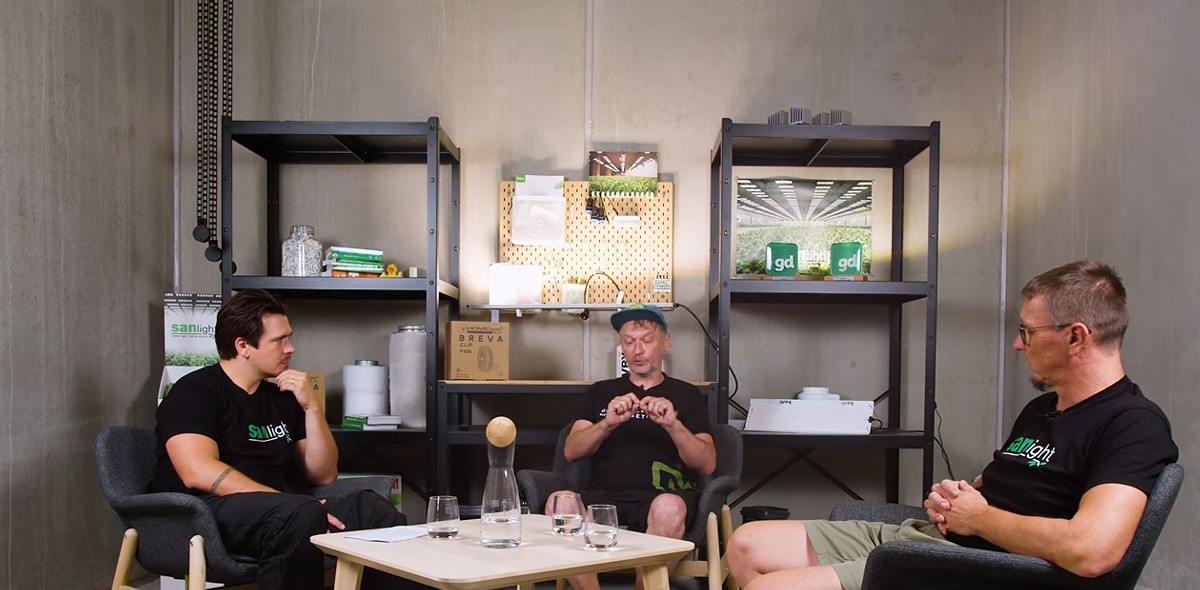
The community asked for it and they are delivering it. The first clone run with clones from Sasha from Gartens. The team welcomed everyone to the Homebox Club and explained that they had started a new trial comparing two different soils, one without peat and one with peat. They were also doing the whole trial with clones from Ginsburg, and Sasha was the guest that day to talk about clones, genetics, and how to make the perfect clone run.
Martin gave a quick summary of what they were doing in the Homebox Club. He explained they were doing an experiment with peat-free soil versus peat soil. The motivation was that peat-free soils have become more and more popular because extracting peat emits a lot of CO2, which negatively influences the climate. Roughly 3% of the earth’s ground area is covered by peat regions, and those peat regions buffer more than double the amount of CO2 despite being just 3%. So peat extraction is destroying the climate. Soil manufacturers in Europe are looking at this, governments are pushing more and more toward peat-free soils. It is not a law at the moment but it is a strong recommendation. Their motivation was to check out if using peat-free soil can lead to the same results and, if so, how to reach those results compared to soil with peat content. Peat is a very good water buffer, it keeps the soil fluffy and structurally stable, those are the big advantages. The disadvantage is the CO2 problem.
They were doing a side-by-side comparison with clones from Sasha from Gartens, the RX genetics. They used 42 plants per site on seven square meters per site and did more or less the same. They would adapt watering, irrigation, and fertilization to the needs of the plants and see if there were different needs or not.
Asked whether they had already seen differences in the beginning, Martin said they were in the second week of veg and definitely saw big differences. The soil with peat started pretty easily, while the peat-free soil ran into troubles starting the plants. Martin is known to increase light intensity pretty fast as well as increase the VPD, meaning decreasing humidity and increasing temperature. They started with 160 micromoles for the first three days and then increased up to 300 micromoles, and on the peat-free side that was too much. They saw red stems on the clones and yellow leaves, meaning the plants took nutrients out of the leaves. After roughly ten days Martin decided to decrease the intensity back to 160 micromoles to give more time for acclimatization. So far the plants were catching up and looking great.
Sasha was asked to give a summary of what he was doing and why they got the RX from him. He started the company Gartens in 2019. Before that he was working with other companies, gardening for them, keeping the mother plants alive and cutting. In 2019 he decided to start his own company to have control. From that time on he has been a specialized producer of clones. He has 32 cultivars in the facility which he maintains alive and keeps in as good a shape as possible. The RX is a strain he bred six years ago, a very easy-to-grow plant. It is a cross between a Shiva’s Kong from 97, brought to their places from Amsterdam in 97, and the father plant is an American plant called Double Crush, which most people would know because it was a line breed between San Fernando OG and Chem 91. Those two plants are very different from each other and do not have any relatives from before. His idea was to create an F1 hybrid, which is a textbook example of how to do an F1 hybrid according to Mendel. You take two different genomes and combine them to get one stable line of F1 hybrid. The RX is easy to grow, you do not need to cut it to make it shorter, it is better not to. Just let it grow as it is, and it is really huge.
Asked what can be expected from the plant and what makes it stand out, Sasha said what makes it stand out is that it is so easy to grow, but on the other hand it is quite demanding because it grows very dense with a very short internodal spacing, which allows big yields in the end. But you still have to know what to cut away to transfer the energy into the right places. It is very easy to maintain, a big feeder, the EC levels can be quite high and it will not be over-fertilized very quickly. The basic idea was to do the experiment with a plant that is not demanding, because a cultivar itself can have a very different character. Some strains are really hard to grow, some are really easy. He chose this one because they should concentrate on the experiment, on what happens with peat-based versus peat-free soil. You should do it with a clone because it is the same plant 90 times, so you can actually see the difference.
Martin noted they could clearly see it was from clones, everything looked the same, especially on the soil containing peat, and they were happy so far. Sasha was asked about the benefits of growing from clones, especially for commercial facilities or clubs in Germany. He explained the two differences between a seed plant and a clone. A seed plant has its own character, and when you make a run with many seeds and different seed plants, standardization is not really there because you have different individuals. When you work with clones it is a standardization, meaning the end product will be the same all the time, whereas it varies with seed plants. Seed plants also have a different root structure and are much easier to start with because the root structure is much stronger. When you cut a plant from a branch and root it, you have helping roots which are not the main root. That is why with non-peat-based soils it is much harder for the roots to penetrate through the media. When you start a clone run you must be very careful how to water it. You have to be really careful not to overwater it because clones have helping roots, they do not have the main root, so they are much more prone to being overwatered, which brings the most problems. Clones are a little bit more sensitive when it comes to water. Standardization is the key because you need a standard product in the end. When people come to a cannabis social club in the future they will want the same product they had three months ago or two years ago. It is always the same genetic, not just a copy, it is the original. With seed plants you just have variations, which is a problem because the customer sometimes wants something standardized, and for the medical market it is the same. A plant has a chemotypical expression, it has chemistry and morphology. This chemistry must be the same, and it is only the same when you make clones. It cannot be the same with seed plants. That is the main thing why the industry uses clones. Especially as a club, if you have a system like the Homebox Club and you are not depending on winter or summer grows and not depending on outside temperature or humidity, then you can basically reproduce the same thing with the same recipe anytime.
Sasha also explained the difference with a clone-only plant. Somebody was producing a seed line and then stopped producing that seed line, but there is only a clone left in the market now. That is what it is called, clone only, because it is a clone from the cultivar which is not produced anymore. Asked about the term breeder cut, Sasha said he does not really agree with that term because people always think it is quality when it is a breeder cut. It does not need to be quality to be a breeder cut. If he bred it and it is his cut, it is a breeder cut, but it does not mean it is high quality. In the end a breeder cut just refers to a plant that somebody who was cultivating or breeding with it uses exactly this phenotype to produce a line after, so he continues the line with this specific cut. That is why it is called breeder cut, but it has nothing to do with quality. It can determine the quality if it is a good breeder, then breeder cut would mean that this is his cut and it is a standard, but it can also mean just that it is a plant left over from the breed and there is no other, that is a breeder cut also.
Asked what a home grower with six, nine, or twelve plants at home can benefit from growing clones and what the main takeaways should be, Sasha said that if he chooses one cultivar and starts it and likes the end product, he can repeat it all the time because it is the same plant all the time. If he starts from seed and has luck, he will find an elite plant, but if you do not clone it, it is gone forever. It will not return. You can try to find it again if it is a good line, but he would suggest to people to try everything, do not just be stubborn on something. You should try both worlds, the cuts and also plant some seeds, just because you will understand the morphology and the process of how to come to an end product that is standing out. That can happen also with seed plants but it is much more time consuming and costs a lot more. Clone producers try to keep some specific cultivars just because they have been very successful in the market. People like them and want them again, so they need to keep them alive to reproduce them so people can repeat it. If it would be just seeds, it would not mean the grower can repeat it because there would be other variations inside.
Sasha was asked about shelf life or lifetime of a mother plant and lifetime of a genetic, and whether the RX back then is the same as it is today or if there is fluctuation. He said there can be fluctuation when you use different media and expose the plant to a different environment. Morphology can drift a little bit, but genetics will never drift. His theory is that there is no genetic drift in a plant in a one-plant life. There is no genetic drift, it is only over generations that genetics can drift. Comparing the new generation of genetics with the older one, he would say the older generation is still not so much multi-hybrid, while multi-hybrid would be the newer generations because seed banks are working more and more without pure lines and there is a lot of S1 production also. There will always be a customer for the old and always a customer for the new, so it is good to have both worlds combined in a company. He kept old genetics alive because at a certain point everybody was throwing stuff away like the old Shiva or the White Widows or the AK-47s or the Critical Blues. People say today this is nothing compared to today, but it does not really fit into the model. The old school smokers, growers, and users will never say no to a very good old strain because it reminds them of a certain time of life.
Looking at terpene content, THC content, and cannabinoid content, Sasha said sometimes it is just a hype. The morphology has changed, leaf-to-bud structure is much less now. Today you do not have cultivars that are so leafy like they used to be because it was bred out. Today there are cultivars with 3% or more terpenes, which was never the case before, maybe one percent of terpenes. But does it determine the quality? He does not think so, because 1% of terpenes can be as effective as 3% just because the combination of terpenes is different. 3% just means it has more of the aroma, but it does not mean it will be much more stinky or much better in taste. Same with THC. He compared it to craft beer producers. Some beers are very heavy in aroma and make you tired because your liver has to process the terpenes more, but the alcohol is the same as a lager. In the end you will have a hangover from the heavy beers with terpenes but the same alcohol as the lager, while from the lager you will wake up no problem. It is the same with THC content in cannabis. It does not mean that when cannabis has 30% it will be the best, it just means it has this content of cannabinoids. The terpenes determine the quality of the end product itself and the entourage effect you get from it. Old versus new, the new will also be old in the future, so what is the standard now? We can go back in history and it is very interesting to see that.
Asked what needs to be done to keep a mother young, Sasha gave a very simple answer: keep her fresh. In his facility they keep the mother plants alive for four months only. When she is two months old, they cut cuttings from her again to prepare the new line of mother plants from that cultivar. Every second month they renew the mother stock, and after four months the mother is changed with a new mom. It is the same cut but it is not woody, because when you go over four months, in the fourth month you can see the structure of the plant is woody, and it is never good to have woody plants for cloning. The material gets older, more prone to diseases and pests, which is also a big problem. Years ago they used to make mother plants and keep them one year, and the stem was so thick you could make a drumstick from it, but that is a bad thing because the clones will always be thinner and woodier, which means they will root much longer than with a younger mom. A younger mom is much more resistant, and the stems are thicker. The basic thing is to keep it, even if it is a cultivar that is 30 years alive, you can keep it if you renew it in a short time, every three or four months you have to have a new mom. Before cutting you do not need to wait two months, you can cut already after one month, but you do not get a lot of clones after one month, maybe you get the side branches from the lowest one which is the easiest to clone, and the hardest to clone is the main apical stem, which is also the thickest, and if you succeed you get a really good clone from that. In the third month the clones are really perfect, so you basically have a window of two months where you take clones from any of your mothers.
Asked which nutrients he uses, Sasha said VBX hydroponic research. They just use VBX because they have one phase and are not allowed to flower anything, so they use it just as a base nutrient. The best thing is that they do not need to supply any enzymes, any root stimulators, nothing. He would say maybe the industry does not want to hear it, but it is much simpler than people think. There is no wonder middle, no stuff that would make it better or make more cannabinoid or terpene content. It is only written in the genetics. Nobody can tell him that the RX will smell better if he treats it with a product from someone. It is the genetics itself and the environment, and if it is a perfect environment it is the perfect end product.
On the best environment for mother plants, looking at temperature, humidity, and light intensity, Sasha said their general recommendation for mothers is roughly 300 to maximum 400 micromoles, and they see that plants age way faster if intensity is increased. For humidity and temperature with mother plants in vegetative state, they always try to keep it from 55 to 70% humidity because it sinks when the plants are drying up. When the day comes that they water them, since they use hand watering in the facility with no automatic watering system, it goes up to 70 and the stomata is still active. It is a really beautiful plant when it is like that, it is shining. Temperature-wise it is ideal to keep it from 25 to 27 degrees. If you go higher they will transpire more and feel more stress. During heat waves it is not always ideal but they try to keep it as ventilated as possible. From the food source they use one component only. The most important thing is that the plants are really well rooted. If you start with clones you should never keep the plants that are not well rooted, you just take the best of the best. The selection between good and bad clones should be done at the beginning of the process, not at the end. That is how you keep good mothers in a perfect environment. If you shift lower or higher from that it will not mean the end of the world, but you should know what the ideal situation is, and that is the ideal situation.
Last but not least, as Germany has decriminalized or legalized the cannabis market, they are confronted with a lot of questions from so-called cannabis social clubs where they do the HVAC system, the lighting system, or build the whole club, and many of those clubs are asking for mother rooms, clone rooms, and veg rooms. Their general recommendation is do not start with this, because on the one hand you need to invest money again and on the other hand many of those clubs underestimate the work which needs to be done while producing mothers and clones. Sasha was asked how many people, how much area, and how many clones he produces with 32 cultivars. He said they grow on 170 square meters with 55 EVO fives in the room. What he mostly wanted to say to the customers and the cannabis social clubs that want to produce their own mother stock and clones and then flower that in one facility is that he would not do it. He is a clone producer, he started like 15 years ago, and he would never do the flower room in his facility today because it would be two segments which would take away the time that is still left in his life. If you are a clone producer you do not have holidays, there is no Christmas Eve, because the plants demand from you when they want it and that is a cycle. It is cost consuming and time consuming, and to also make all the mistakes that he made over the years would cost a fortune, you would lose a lot instead of gain a lot. So he recommends buying from him because he knows his job and will produce the best clones he can, and after years you can do it yourself, no problem. But do not start your company with the idea of managing everything by yourself, that is not a good idea. Keep it simple and focus on what matters.
That was from his point. All questions were done. They said they had talked about everything, would definitely visit him in his facility, and would also have another look at the plants when they are in full flower. They thanked everyone for watching and reminded them to like, subscribe, and follow. See you soon.
Key Findings Summary
The Homebox Club trial compared peat-free and peat-based soils using 42 genetically identical RX clones per site (seven square meters per site), supplied by Sasha of Gartens. The trial set out to determine whether peat-free soil can match peat-based soil and, if so, what it takes to get there.
The most significant finding was that peat-free soil proved far less forgiving during the acclimatization phase. While plants in peat-based soil started easily, the peat-free plants showed stress symptoms (red stems and yellowing leaves indicating nutrient drawdown) when light intensity was pushed to 300 micromoles. Martin reduced intensity back to 160 micromoles, after which the peat-free plants began catching up.
The root of the difference lies in root architecture. Clones develop helping roots rather than a strong main root, making them more sensitive to overwatering and less able to penetrate dense media. Peat’s water-buffering and structural fluffiness compensate for this weakness, while peat-free media demand more careful irrigation and slower acclimatization.
Standardization was the central theme. Sasha emphasized that clones deliver a consistent end product every time, which is essential for commercial facilities, cannabis social clubs, and especially the medical market, where chemical and morphological expression must remain identical. Seed plants cannot achieve this.
Mother plant management was identified as the most underestimated task. Sasha keeps mothers for only four months, renewing stock every two months, because woody stems root more slowly and attract disease and pests. Ideal conditions are 55 to 70 percent humidity, 25 to 27 degrees Celsius, and 300 to 400 micromoles of light. Higher intensity accelerates aging.
On genetics and quality, Sasha argued that genetics never drift within a single plant’s life, only across generations. Higher terpene or THC percentages do not equal higher quality. The combination of terpenes and the entourage effect determine the end product, much like the difference between a heavy craft beer and a lager of the same alcohol content. Nutrition is simpler than the industry suggests. A single base nutrient suffices, as cannabinoid and terpene content is written in the genetics, and the environment determines the final result.
The bottom line for cannabis social clubs: do not attempt to produce mothers and clones in-house alongside flowering. It requires separate segments, constant attention with no holidays, significant investment, and years of costly mistakes. Buy from specialists and keep it simple.
Comparison Table
| Aspect | Peat-Based Soil | Peat-Free Soil |
|---|---|---|
| Start of trial | Plants started easily | Struggled to start; ran into troubles |
| Response to 300 micromoles | Tolerated well | Too much; showed red stems and yellow leaves (nutrient drawdown) |
| Required light adjustment | None needed | Reduced back to 160 micromoles for acclimatization |
| Root penetration | Easier; peat’s fluffy structure helps roots | Harder; denser media resists helping roots |
| Water management | More forgiving; peat buffers water well | More sensitive; higher risk of overwatering |
| Structural stability | High; peat keeps soil fluffy and stable | Lower; requires more careful irrigation strategy |
| Current status (week 2 veg) | Looking great; uniform | Catching up; now looking great |
| Environmental impact | Negative; peat extraction emits significant CO2 | Positive; avoids peat extraction and CO2 release |
| Legal and regulatory trend | Being phased down; strong government recommendations in Europe | Increasingly favored; pushed by governments and soil manufacturers |
| Best suited for | Growers wanting an easier start and more forgiveness | Growers willing to adapt watering and acclimatization carefully |
Clones vs. Seed Plants
| Aspect | Clones | Seed Plants |
|---|---|---|
| Standardization | Full; identical end product every run | Variable; each plant has its own character |
| Root structure | Helping roots; no main root; prone to overwatering | Strong main root; easier to start |
| Repeatability | Yes; same plant indefinitely | No; elite plants lost forever if not cloned |
| Medical and commercial suitability | Essential; consistent chemistry and morphology | Unsuitable; chemotypical expression varies |
| Cost and time | Higher upfront; requires mother stock management | Lower upfront; more time to find elite plants |
| Best for | Commercial facilities, clubs, consistent home grows | Home growers exploring genetics and discovery |
Recommendations
| Aspect | Recommendation |
|---|---|
| Mother plant lifespan | Four months maximum; renew stock every two months |
| Mother room humidity | 55 to 70 percent |
| Mother room temperature | 25 to 27 degrees Celsius |
| Mother light intensity | 300 to 400 micromoles maximum |
| Nutrition | Single base nutrient (VBX); no enzymes or root stimulators needed |
| Clone selection | Select the best-rooted clones at the start, never at the end |
| Terpene and THC content | Percentage is not quality; combination and entourage effect matter |
| Genetic drift | None within a single plant’s life; only across generations |
| Cannabis social clubs | Do not produce mothers and clones in-house alongside flowering; buy from specialists |


